
Oven Not Heating Properly: Common Problems and Solutions
Your cookies burn on the bottom but stay raw in the middle. Or dinner takes twice as long as the recipe says. An oven not heating properly can turn a simple meal into a guessing game. Luckily, most heating problems trace back to a handful of parts.
Here is what usually goes wrong with electric and gas ovens, and what you can do about it.
Confirm the Problem First
Ovens can drift a little over time. Before assuming something is broken, place an oven thermometer on the middle rack. Preheat to 350°F and wait about 20 minutes. Check the reading without opening the door if possible.
If your oven is within 10 degrees, it is working normally. If the gap is larger, or the oven barely warms, keep reading.
Electric Oven Problems
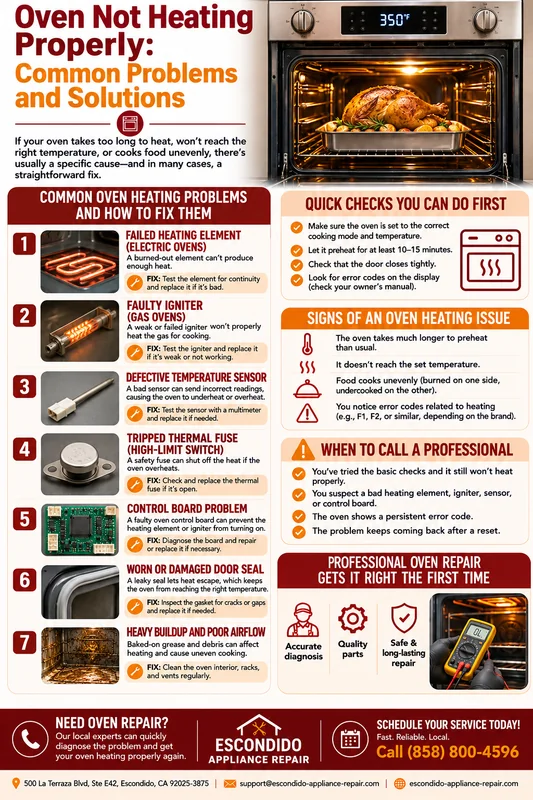
Bake element failure. The bake element sits at the bottom of the oven cavity. When it burns out, you may see a visible break, a blister, or a bright spot. Without it, the oven may only heat from the top, or barely at all.
Broil element failure. The broil element sits at the top. Many ovens use it during preheat too. A failed broil element can slow preheating and cause uneven baking.
Temperature sensor issues. This thin metal probe inside the oven reports temperature to the control. If it reads wrong, the oven will run too hot or too cold. A technician checks its resistance against factory specs.
Electrical supply. Electric ranges use a 240 volt circuit. If one breaker trips, some functions may work while others fail.
Gas Oven Problems
Weak igniter. This is the number one cause of gas oven heating issues. The igniter must get hot enough to open the gas valve. As it ages, it still glows but no longer pulls enough current. The result is an oven that never lights or takes forever to heat.
Gas safety valve. If the igniter is fine but no gas flows, the valve may be faulty. This repair requires care and proper testing.
Gas supply problems. Make sure the shutoff valve behind the range is open. If your stovetop burners also fail, the issue is upstream.
If you ever smell gas, leave the house and call SDG&E or 911 from outside. Do not try to troubleshoot a gas leak yourself.
Uneven Baking Without a Broken Part
Sometimes the oven heats fine, but results are inconsistent. A few habits can make a big difference.
- Let the oven preheat fully before putting food in
- Avoid lining the oven floor with foil, which blocks airflow
- Leave space between pans so heat can circulate
- Rotate trays halfway through baking
- Use light colored metal pans for more even browning
Dark pans and glass dishes absorb heat differently. You may need to lower the temperature slightly when using them.
Door Seal and Fan Issues
A worn door gasket lets heat escape and forces the oven to work harder. Run your hand around the seal and look for gaps or flattened spots. In convection ovens, the rear fan circulates hot air. If it stops spinning, you lose that even heat and may hear a grinding noise.
Control Board Failures
Modern ovens use electronic control boards. A failing board may show error codes, refuse to hold a set temperature, or stop responding entirely. Power surges and heat from self cleaning cycles are common triggers. Board repairs need careful diagnosis, since the symptoms often overlap with sensor problems.
Calibrating Your Oven Temperature
Many ovens let you adjust the temperature offset yourself. If your oven runs consistently 10 or 15 degrees off, this can fix it without any parts. Check your owner’s manual for the calibration steps. On most digital models, you hold a button combination to enter a settings menu. Older dial ovens often have a small screw behind the knob. Write down the change you make so a technician knows about it later.
Calibration only works when the oven is off by a steady amount. If temperatures swing wildly or the oven barely heats, a part is failing. In that case, adjusting the settings will only hide the problem.
Preheating Takes Longer Than You Think
The preheat beep does not always mean the oven is ready. Many ovens signal when the air reaches temperature, but the walls are still catching up. Give it another ten minutes for even results, especially when baking bread or pastries. A pizza stone inside the oven also helps hold steady heat.
If your oven has a convection setting, lower recipe temperatures by about 25 degrees. Convection cooks faster, so many people mistake it for an oven running hot.
Also avoid opening the door to check progress. Each peek can drop the temperature by 25 degrees or more. Use the oven light instead. A steady oven makes every recipe easier to trust.
Professional Oven Repair You Can Trust
If your oven is still not heating right, it is time for an expert look. For more than two decades, Escondido Appliance Repair has been the call local cooks make when baking goes sideways. Our technicians have over 15 years of experience repairing gas and electric ovens, ranges, and wall ovens. We test each component, explain what we find, and fix it right the first time.