
Garbage Disposal Jammed or Humming: Safe Ways to Fix It
You flip the switch and hear a low hum. Nothing spins. Water starts backing up into the sink. A jammed garbage disposal always seems to strike at the worst time, usually right after dinner.
The upside? Most jams can be cleared in a few minutes with basic tools. The key is doing it safely.
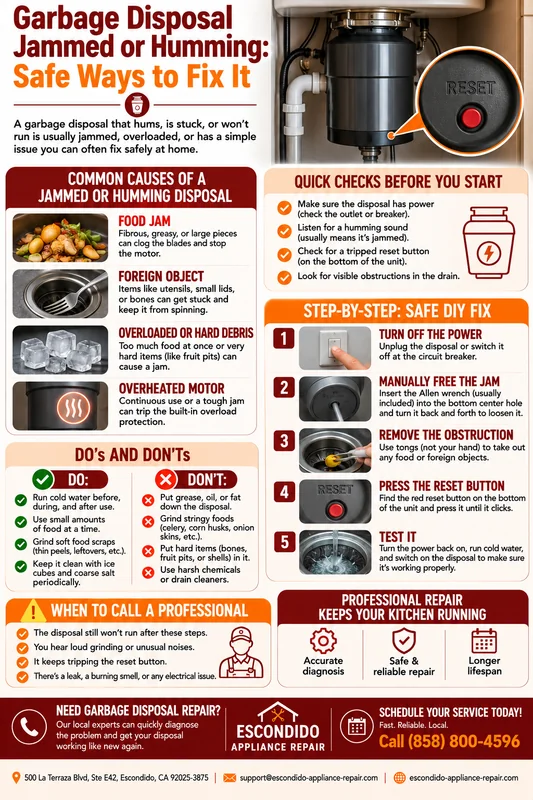
Why Disposals Jam
A garbage disposal grinds food with spinning impellers against a grind ring. When something hard or fibrous gets wedged in, the motor cannot turn. That humming sound means the motor is getting power but cannot move.
Common troublemakers include:
- Fruit pits and bones
- Corn husks and celery strings
- Potato peels in large amounts
- Pasta and rice, which swell with water
- Grease that hardens in the drain
- Small objects like bottle caps or silverware
Step One: Cut the Power
Turn off the disposal switch first. Then unplug the unit under the sink or switch off the breaker. Never put your hand inside a disposal, even when it seems off. If you need to remove an object, use tongs or pliers.
Step Two: Free the Flywheel
Look at the very bottom center of the disposal, under the sink. Most models have a small hexagonal socket there. Many disposals ship with a matching wrench, often called a jam buster. A standard 1/4 inch Allen key usually fits too.
Insert the wrench and work it back and forth. You will feel resistance at first. Keep rocking it until it turns a full circle freely. This breaks up whatever is wedged inside.
Step Three: Remove the Debris
With the power still off, shine a flashlight down the drain. Pull out any loose objects with tongs. Do not skip this step, or the jam will return the second you turn it on.
Step Four: Press the Reset Button
When a disposal overheats from a jam, its thermal overload trips. Find the small red button on the bottom of the unit. Press it firmly. If it does not stay in, wait about ten minutes for the motor to cool and try again.
Step Five: Test It
Restore power. Run cold water and turn the disposal on. It should spin smoothly. Let the water run for 30 seconds to flush any remaining particles through the drain.
What If It Still Will Not Work?
If the disposal keeps humming after you cleared the jam, the motor may be damaged. If it makes no sound at all, check the reset button and the breaker again. Still silent? The switch or wiring could be at fault.
Other signs of a bigger problem include:
- Water leaking from the bottom of the unit
- Frequent jams even with careful use
- Grinding noises that sound like metal on metal
- A burning smell when running
A leak from the bottom usually means the internal seals have failed. That typically calls for a replacement rather than a repair.
How to Prevent Future Jams
A disposal is not a trash can. A few habits go a long way.
- Always run cold water before, during, and after grinding
- Feed food scraps in gradually, not all at once
- Keep grease, oil, and coffee grounds out of the sink
- Cut large scraps into smaller pieces
- Grind citrus peels occasionally to keep it smelling fresh
Cold water keeps any fats solid so they get chopped and flushed instead of coating the pipes.
Myths About Garbage Disposals
A few popular tips actually do more harm than good.
Myth: Ice cubes sharpen the blades. Disposals do not have blades. The impellers are dull by design. Ice can help knock loose buildup, but it does not sharpen anything.
Myth: Hot water helps grease go down. Hot water melts fat, which then cools and hardens farther down the pipe. Cold water is the better choice.
Myth: Eggshells clean the drain. The thin membrane inside shells can wrap around the impellers. Ground shells also form a sandy sludge in pipes.
Myth: Any food is fine if you run enough water. Stringy and starchy foods cause jams no matter how much water you use.
Myth: Bleach is the best way to clean it. Harsh chemicals can damage rubber parts. A mix of baking soda and vinegar, followed by cold water, works better.
How Long Should a Disposal Last?
Most garbage disposals last about eight to twelve years. Heavier use and cheaper models wear out sooner. Signs of age include frequent jams, slow grinding, and rust on the unit. When a disposal starts leaking from the body, replacement is usually the only fix.
Horsepower also plays a role. Smaller half horsepower units handle light daily use. Larger households that cook often do better with three quarter or one horsepower models. A stronger motor grinds faster, jams less, and usually lasts longer. If you are replacing an old unit anyway, sizing up is often worth it. Ask a technician which size fits your kitchen before you buy. The right match saves you from another jam.
Get Help From Local Pros
Some disposal issues go beyond a quick fix. If yours is leaking, smelling, or failing to start, we are a phone call away. Escondido Appliance Repair has been part of this community since 2001. Our people have handled disposals and every other kitchen appliance for more than 15 years. We will tell you honestly whether a repair makes sense or a new unit is the better call.