
Ice Maker Not Working? A Simple Troubleshooting Guide
There is nothing quite like reaching for ice on a hot Escondido afternoon and finding an empty bin. An ice maker not working is one of the most common refrigerator complaints. It is also one of the most fixable.
Before you assume the worst, run through these checks. Many ice maker problems take minutes to solve.
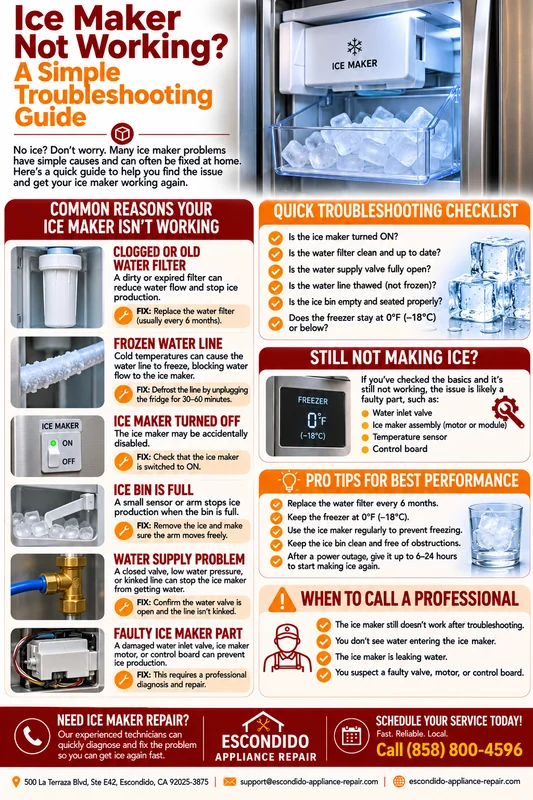
Make Sure It Is Turned On
It sounds silly, but check it anyway. Many ice makers have a wire arm or a switch that turns production off. If the arm is raised or locked in the up position, the ice maker thinks the bin is full. On newer fridges, ice production may be controlled from the display panel. Kids and cleaning sessions are frequent culprits.
Check the Freezer Temperature
Ice makers need the freezer to stay cold. Most work best when the freezer is at 0°F to 5°F. If it runs warmer, ice production slows or stops completely. A freezer that is too warm may also point to bigger cooling problems.
Look at the Water Supply
No water means no ice. Several things can block the flow.
- Shutoff valve: Make sure the valve behind the fridge or under the sink is fully open.
- Kinked supply line: Pushing the fridge back can pinch the line.
- Frozen fill tube: The tube that feeds water into the ice maker can freeze solid. You may see ice inside it.
If the water dispenser works but the ice maker does not, the problem is likely inside the freezer.
Replace an Old Water Filter
A clogged water filter reduces flow to a trickle. The ice maker may produce small, hollow, or misshapen cubes. Most manufacturers recommend replacing filters every six months. In North County, hard water and sediment can clog them sooner. If yours is overdue, this may be the easy fix.
Thaw a Frozen Fill Tube
To thaw it, unplug the fridge or turn off the ice maker. Use a hair dryer on low heat aimed at the tube. Be patient and keep the dryer moving. Never use sharp tools to chip away ice. Once the tube clears, restore power and wait several hours for new ice.
A tube that keeps freezing often signals low water pressure or a failing inlet valve.
Clear Ice Jams
Sometimes cubes fuse together in the bin. This blocks the auger or keeps the arm from dropping. Empty the bin, break up any clumps, and look for cubes stuck in the ice maker itself. If you use ice rarely, cubes are more likely to clump.
Signs of a Failed Part
If none of the above helps, a component may be faulty.
Water inlet valve. This valve opens to let water in. Mineral buildup from hard water often causes it to stick or fail.
Ice maker module. The motor and controls that eject ice can wear out. You may hear it try to cycle without producing ice.
Auger motor. If ice forms but will not dispense, the auger motor may be the issue.
Door switch. On dispenser models, a faulty door switch can stop ice from coming out.
Be Patient After Repairs
A new or repaired ice maker usually needs 24 hours to produce a full bin. Throw out the first few batches. They can taste odd from new parts or water lines.
Why Ice Tastes or Smells Bad
Sometimes the ice maker works fine, but the ice tastes off. Ice absorbs odors from food stored in the freezer. Uncovered leftovers, fish, and onions are common offenders. Keep food sealed and toss old items.
An old water filter can also give ice a stale or metallic taste. If ice sits in the bin for weeks, it can pick up a freezer burn flavor. Empty the bin and wash it every few months. Hard water can make ice cloudy, which is harmless but less appealing.
Small or Hollow Cubes
Tiny cubes usually point to low water flow. A clogged filter is the most common reason. Low household water pressure or a partly frozen fill tube can also cause it. Hollow cubes often mean the ice maker ejects them before they fully freeze. That may signal a warm freezer or a faulty thermostat in the ice maker.
Water Spilling From the Mold
Water dripping from the ice maker or forming ice sheets on the shelf is not normal. The fridge may not be level, so water spills out of the mold. A failing inlet valve that does not close fully can also overfill it. Check that the fridge leans back slightly and that cubes form evenly.
Smart Fridge Settings
Many newer refrigerators control the ice maker through an app or touchscreen. A software update or a power outage can reset these settings. Check that ice production is enabled and that no vacation or energy saving mode is active.
Some models also pause ice production when the door stays open too long. Close the door firmly and give it a few hours. If the settings look right and nothing changes, the issue is likely mechanical. In that case, a technician can test the module, the valve, and the controls in one visit.
Professional Ice Maker Repair
If your ice maker still refuses to cooperate, we are glad to step in. Escondido Appliance Repair has fixed ice makers in this area since 2001. Fifteen plus years of refrigerator work means our techs have seen nearly every ice maker design out there. We will find the real cause and keep the ice coming all summer long.