
Gas Stove Burner Won’t Light: Troubleshooting Tips
You turn the knob, hear the click, click, click, and nothing happens. Or the burner lights for a second and then goes out. A gas stove burner that will not light can stop dinner in its tracks. Fortunately, the cause is often something you can fix with a little cleaning.
Here is how to troubleshoot it safely.
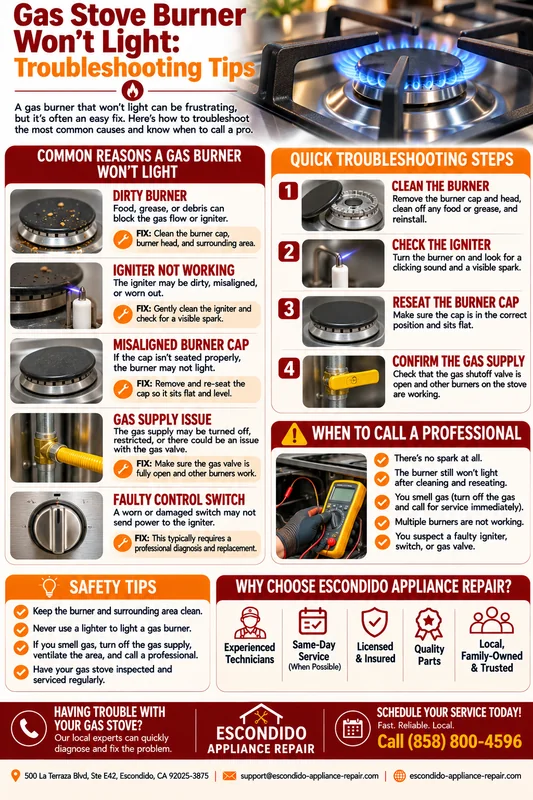
Safety Comes First
If you smell gas strongly in your kitchen, stop. Do not flip switches or light anything. Leave the house and call SDG&E or 911 from outside. If there is no gas smell, you can safely continue. Turn all burner knobs off and let the stovetop cool before you start.
Is It One Burner or All of Them?
This question narrows things down fast.
If only one burner fails, the problem is usually local to that burner. Think dirty ports, a misaligned cap, or a worn igniter.
If all burners fail, look at bigger picture issues. The gas supply could be off, or the range may not have power for the igniters. A tripped breaker or unplugged cord can cause this.
Clean the Burner Ports
Food spills and grease clog the tiny holes where gas comes out. Remove the grate, burner cap, and burner head. Soak them in warm, soapy water for about 15 minutes. Use a straightened paper clip or a sewing needle to clear each port.
Avoid wooden toothpicks here, since tips can snap off inside the ports. Never pour water directly on the igniter. Let all parts dry completely before putting them back. Wet burners often refuse to light.
Check the Burner Cap Position
A burner cap that sits crooked can block gas flow or keep the flame from catching. Make sure each cap sits flat and centered on its base. On many stoves, the cap should not wobble at all. This tiny detail fixes more problems than you would think.
Inspect the Igniter
The igniter is the small white ceramic piece next to each burner. When you turn the knob, it should spark.
- No spark at all: The igniter may be cracked, dirty, or disconnected.
- Weak spark: Grease or moisture may be coating it.
- Spark but no flame: Gas is not reaching the burner, or ports are clogged.
Gently clean the igniter tip with a dry toothbrush or a cotton swab with rubbing alcohol. If you see a crack in the ceramic, the igniter needs replacing.
Constant Clicking After the Burner Lights
This is a common complaint. Usually it means moisture got into the igniter switch, often after a boil over or cleaning. Let the stove dry for a day. Remove the knobs and wipe around the switches. If clicking continues, the spark switch may need replacing.
Flames That Look Wrong
Healthy gas flames are mostly blue with a small inner cone. Pay attention if you notice:
- Yellow or orange flames
- Flames that lift off the burner
- Uneven flames around the ring
- A burner that goes out by itself
These signs can point to clogged ports, the wrong air mixture, or problems with gas pressure. Yellow flames can also produce more carbon monoxide. Have a professional check it.
When to Call a Technician
Some repairs are best left to a pro. Call for help if:
- Cleaning and drying did not solve the problem
- The igniter, switch, or wiring needs replacement
- Several burners fail at once
- Flames remain yellow after cleaning
- You suspect a gas valve issue
Working on gas appliances requires proper training. A small mistake can create serious safety risks.
Sealed Burners vs Open Burners
Most modern ranges have sealed burners. The burner sits on a base that keeps spills from dripping into the range. They are easier to clean, but spills sit right on top of the igniter area.
Older and professional style ranges often use open burners. Spills drop down into a tray below. These burners need occasional removal and deeper cleaning underneath. Knowing which type you have helps you clean the right way.
Daily Habits That Prevent Burner Problems
- Wipe spills as soon as the stovetop cools
- Use pots that match the burner size
- Avoid spraying cleaner directly onto the knobs or igniters
- Keep lids on pots that tend to boil over
- Lift grates carefully so you do not knock caps out of place
Boil overs are the main reason igniters get wet. A little attention while cooking saves a lot of clicking later.
Check Your Gas Connector
Behind the range, a flexible connector links the stove to the gas line. Older connectors made of uncoated brass can crack over time. If yours looks old or corroded, have it replaced by a professional.
Never try to tighten or replace gas fittings yourself. Even a small leak can create a serious hazard. A licensed technician uses the right sealant and tests every joint with a leak detection solution. That simple check gives you real peace of mind every time you cook. If you smell even a faint trace of gas near the connector, leave that job to the pros immediately.
Reliable Stove Repair in Escondido
Escondido Appliance Repair has kept North County burners lit since 2001. Our technicians have spent more than 15 years servicing gas ranges, cooktops, and ovens of every make. We diagnose the problem safely and get your stove working again. Call us and get back to cooking.